

Don’t Turn a Blind Eye to Safety: The Clear-Sighted Guide to OSHA Compliance
- Apr 20
- 3 min read
The Occupational Safety and Health Administration (OSHA) estimates that workplace eye injuries cost hundreds of millions of dollars annually in lost productivity and medical expenses. Yet, perhaps the most striking statistic is that 90% of these injuries are preventable with proper eye protection and safety protocols.
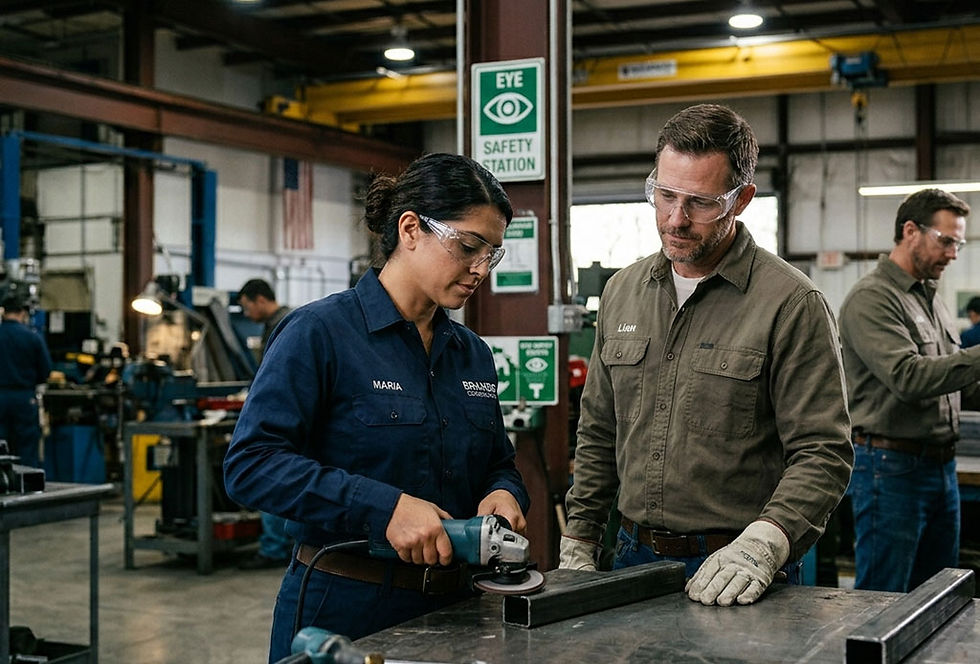
In 2026, OSHA’s focus has shifted beyond merely "wearing glasses" to a more holistic approach involving individual fit, advanced lens technology, and administrative controls.
OSHA Eye Safety: The Core Standards: 29 CFR 1910.133
OSHA’s primary regulation for eye and face protection requires employers to ensure that every affected employee uses appropriate protection when exposed to hazards from:
Flying particles (dust, dirt, metal, or wood chips)
Molten metal
Liquid chemicals (acids or caustic liquids)
Chemical gases or vapors
Potentially injurious light radiation (welding arcs, lasers)
Key 2026 Update: OSHA now emphasizes the "Right Fit" mandate. Universal-fit PPE is often deemed non-compliant if it leaves gaps. Gear must be sized specifically for the individual’s facial structure to prevent debris from "sneaking" behind the lenses.
Take the first step toward a safer workplace. Contact D&D Safety Consulting today at 216-352-1900 to schedule your FREE consultation.
Industry-Specific Hazards and Solutions
1. Construction and Trades
The construction industry has the highest rate of eye injuries. Workers often face "multidirectional" hazards where debris can fall from above or be kicked up from the floor.
Primary Hazards: Nails, slivers of wood, cement dust, and "recoil" from power tools.
Protection: Safety glasses with permanent side shields are the baseline. For high-dust tasks like grinding or sawing, ventilated goggles are required to create a seal against the face.
2. Manufacturing and Metalworking
In manufacturing, the danger is often high-velocity impact.
Primary Hazards: Metal shavings from lathes, sparks from grinding, and chemical splashes in assembly lines.
Protection: Impact-rated spectacles meeting ANSI Z87.1 standards. When working with chemicals, a face shield must be worn over safety goggles—a face shield alone is not enough to protect against splashes that can wrap around the shield.
3. Healthcare and Laboratories
Eye safety in healthcare focuses on biological hazards rather than physical impact.
Primary Hazards: Splashes of bloodborne pathogens, respiratory droplets, and chemical reagents.
Protection: Non-vented or indirectly vented goggles that prevent liquid penetration. Face shields are used during procedures with high splash potential (e.g., surgery or suctioning).
4. Specialized Environments (Welding & Lasers)
Light radiation can cause "Welder’s Flash" (photokeratitis)—essentially a sunburn on the eye.
Protection: Welding helmets must use specific Filter Shade Numbers based on the arc current. Using the wrong shade is a common OSHA violation.
The "Digital Eye Strain" Epidemic
While not a physical trauma, Computer Vision Syndrome (CVS) is now recognized in corporate safety audits. With the average worker spending over 7 hours a day on screens, OSHA best practices now include:
The 20-20-20 Rule: Every 20 minutes, look at something 20 feet away for 20 seconds.
Blue Light Ergonomics: Adjusting ambient lighting to reduce screen glare and ocular fatigue.
Emergency Response: The 15-Minute Rule
If an injury occurs, especially a chemical splash, the first 10 seconds are critical.
Eyewash Stations: Must be reachable within 10 seconds (roughly 55 feet).
Tepid Water: OSHA enforcement now strictly requires "tepid" water (between 15.5°C and 37.7°C). Water that is too cold can cause thermal shock, while water too hot can accelerate chemical reactions in the eye.
Flush Duration: Most chemical exposures require a full 15-minute continuous flush.
Employer Responsibilities ChecklistTo remain compliant and protect staff, employers must:
|
By moving from a culture of "compliance" to a culture of "care," businesses can ensure their most valuable tools—their employees' eyes—remain protected.
Take the first step toward a safer workplace. Contact D&D Safety Consulting today at 216-352-1900 to schedule your FREE consultation.


Comments